Una serie de acotaciones al margen a medida que voy leyendo algunos libros... A series of annotations whilst reading interesting books... A collection of notes on books about science, SciFi, history, others topics... Una colección de notas sobre libros de ciencia, ciencia-ficción, historia, otros...

Showing posts with label religion. Show all posts

15 January 2017

Dennet's Breaking the Spell - Chapter Two review

Chapter 2 opens with a question: Can science study religion?

Like all opening question the answer is a yes. However Dennet as a philosopher goes into a discussion of science and it's limits and if religion falls into its domain of study.

He questions why religion has evaded scientific study. Part of the blame is in the social dynamics: no one likes to be hanging around second rate professionals, and studying religion is surrounded by an aura of "low prestige, backbiting, and dubious results that currently envelops the topic of religion" (pages 33 - 34).

Clearly organizations like Templeton do not help and maybe it is a way to put a soft fence around a good, objective and rational study of science. Also questions that are raised suspiciously between family members and friends. People just let it go, including when everybody agreed in its atheism, or prefer not to insult "cultural sensitives". Dennet puts it succinctly "since we know from the outset that many people think such research violates a taboo, or at least meddles impertinently in matters best left private, it is not surprising that few good researchers, in any discipline, want to touch the topic" (page 34). How convenient for religion in general!

Categorically Dennet states that "the question is not whether good science of religion as a natural phenomenon is possible: it is."

And he launches his next question "the question is whether we should do it" (page 34)

What could happen if something that you do as part of your group it is deemed to be unhealthy, Or wrong? Would you stop doing it right away? Which will be your first reaction? Anger, defensive outrageous cries, or just saying "this is the way it is. It always have been like this".

Dennet makes a parallelism with music. If studies reveal that music is bad, what would be your reaction? Good example as several extreme forms of religious belief, up to some extent most of the Abrahamic religions condemn music and enjoying it at all or in some degree. Also music has been studied in different disciplines including evolutionary biology. In some way it should be some biological explanation and in some cases and evolutionary basis (not all traits and behaviors should have it, they can be co-opted also). We like it or not most of our behavioral traits they have a big genetic influence, whilst culture has rocketed the Homo sapiens in a fast forward line of changes.

Most people enjoy music and believe that it is good: we go to concerts, stream it, learnt and add to the school's curricula as well.

If studies show that music is bad, will concerned parents stop playing it to their kids including when they are in the womb?

There is a range of other possibilities: music is not bad at all, but it's scientific study could destroy the speak it has on humans, rendering music as a non-sense maybe dull or boring activity. Like for a grown up kid playing with her toys could mean: the magic is gone and you do not want to play anymore.

Dennet goes strong in this: show me he evidence. "In spite of all warnings over the centuries, I have been unable to come up with a case of some valuable phenomenon that has actually been destroyed, or even seriously damaged, by scientific scrutiny" (page 45)

We can all feel relieved : music is here to stay and our understanding of it enhances our appreciation rather than destroying the enchantment. In the worst scenario those parents worrying so much about their future kids intelligence maybe they could play any music they like instead of sticking to some oil snake salesman product and kill themselves to boredom with the likes such as Baby Bach: if you like classic just go for the interpretations you most admire, if you like rock just rock&roll your babies!

Dennet continues with another taboo. So big that until just a few years ago there was no scientific research and anyone attempting it was considered a second class scientist in he best case: sex. Clearly we know much more, still we have a lot to understand but no one can say that "knowing" destroyed the pleasure of it.

Or not. Lot of research is how sex is used in power driven and abusive interactions. The more we know, the better, isn't it?

More the benefits derived by its scientific study overwhelm any wrong deduction: from a social and political and individual level. Ironically the biggest religions keep their outdated and moralistic attitudes against sex, however all the data telling the contrary. And we know that all about sex is not good, and neither is bad. And still we do not know a lot, so we keep studying it.

There are other issues about trying to stop scientific inquiry: the genius is out of the bottle, and it is very difficult bear to impossible to keep this knowledge from spreading.

This strong sentiment against scientific scrutiny of human activities it is not only seen dangerous by religion advocates. It is a widespread sentiment that run in all cultures, and percolates to pop culture. I think of Mary Shelley's Frankestein to Tim Burton's Nightmare before Christmas: from trying to understand what's life to figure out Christmas. In one extreme knowing is Pandora box releasing terrible things on us, in the other is science dissecting a cherished human value and rendering it obsolete or dull. Like proving god, the burden is on the people trying to say that knowledge can be dangerous or kill core human aspects. The question to them: what's core to human nature? Do we know if do not study it?

If religion is like Santa Claus, it will be regarded as a child story. If it is like music or sex we will have a better understanding and enjoy it and benefit from it at a different level. And most important it will influence policies and costumes in our societies that could prove important for our own survival.

Dennet states at the end of the chapter the moral dilemma: what if religion is what keep us humans moral? Prevent us of wrongdoings and evil? If it's effect disappears like the Santa Claus myth, is it not a dangerous path to follow? (he elaborates from page 49 until the end of the chapter, page 53)

Dennet agan is clear about it "religion is not out-of-bonds to science, in spite of propaganda to the contrary from a variety of sources. Moreover, scientific inquiry is needed to inform out most momentous political decisions. There is risk and even pain involved, but it would be irresponsible to use that as an excuse for ignorance" (page 53)

Books and References

From the fantastic and super informative blog Probably Overthinking It by Allen Downey, take a careful read on:


11 January 2017

Breaking the Spell by Daniel Dennet - On Chapter 1 and the book


Daniel Dennet writes in Breaking the Spell a compelling introduction in a very open way and trying not to preach to the (atheist) chores, or his usual readers. He aims at reaching in a honest and brave dialog the religious mind people.


"Billions of people pray for peace, and I wouldn't be surprised of most of them believe with all their hearts that he best path to follow to peace throughout the world is a path that runs through their particular religious institution (...) indeed many people think that the best hope for humankind is that we can bring together all the religions of the world in a mutually respectful conversation and ultimate agreement on how to treat each other. They may be right, but they don't know" (page 16)


The first chapter is a carefully built argument that we truly do not know what are the effects of religion. At both individual and social level.


The argument goes both ways: to the ones that we believe religion is a source of problems, to a great majority that believe humans can not go without religion.


Dennet brings the point forwards that there is an asymmetry: atheists welcome the objective examination of their views (and willing to change if found wrong), but religious people often bristle at the impertinence, lack of respect, sacrilege at the suggestion of putting their beliefs under scrutiny.  (page 17)


And I have to add that it brings suspicion to their claim the simple reason that there are different and contradictory beliefs systems worldwide! A quick check put the number in the several thousands (more than 4000). It does not help that diversity to favor the argument of one true religion (or system of belief).

To bring the religious people to a rational analysis of their beliefs, first they should explain why there are so many religions!

For Dennet the opposition to analyze religions objectively and rationally it is an spell that must be broken. He emphasizes that it must be addressed now. When now was 2006! Ten years later this statement is still un-answered and critical as ever as much and much more religious ideas are entrenched as sacred and beyond any criticism. If there is something that express the most dangerous side of religious belief (my opinion, not Dennet's) it is the level of care that atheist, non religious or brights have to go in order to have a conversation with religious people.

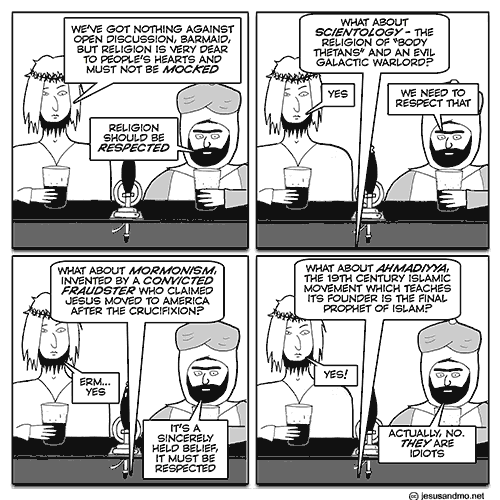
Religion's belief is an off-topic most of the time. Including between friends. Dennet anticipates that his book will be offensive, repulsive at the level of people abandoning it. He anticipates a roller coaster of emotions. Most of the religious people he interviewed researching for the book admitted never talked to anyone like him: an atheist a non believer.

He mentions that these topics are delicate, about embarrassing communications and whatever his efforts to treat the matter with kindness and respect, he is sure that he will outrage some readers (religious people of course).

He ask those potential readers to soldier the effort to read his book and consider carefully and rationally in which points they disagree and why.

If you think that this is exaggerated, just read the news were people gets attacked because they are blasphemous, something that spread from religious countries to secular countries.

The self censorship of many newspapers not publishing the first page of the Charlie Hedbo magazine after the hideous attack to their offices it is a clear sign of this problem.


Dennet will explore in following chapters more about how ideas (memes) that build their own ideas to protect themselves can be dangerous. Religion belief, as a meme/idea, self-protect with circles of convoluted logic. And with other ideas that reject a priori any logical analysis.

How many times an atheist is confronted with incredulity and being asked things like: you do not believe? How comes you are a good person? (and some others: http://www.alternet.org/belief/9-questions-atheists-might-find-insulting-and-answers)

Other ideas to help fence the main idea (belief on belief) are things like all religions are the same, and the basic behavior of separating people from one belief from another and particular atheists.

If you need one more argument, here a short story:


With names and relationships edited, for the reasons stated above (!)

This is the story of two friends: one is very religious, or comes from a very religious family; the other the family does not care about the topic and they do not have any religious affiliation: nones. [Dennet will go on his book more about the topic if children should be indoctrinated with their parent's religion]. The religious kid is sent every summer to a camp in UK. A religious based summer camp. They invited the other kid and the family said "yes, go if you want".

The 2 kids had a great week, and the activities were super well organized. The people were professional and know what they were doing, and they were super nice.

Most of the activities are what you expect from a summer camp in the outdoors: hiking, games, songs, organizing the camp, etc. And the 2 kids had a fantastic time together.

Being a religious based camp of course there is religion: only 5% of the activities were about talking on religion  (christian based Church of England). Several questions our daughter asked to us about that. And this little gem.

One day in the summer camp, they talked about hell, and that people that do not believe go to hell automatically [express application form I would say]. The religious friend concerned about her non-religious friend asked to the nice people that if she prays every night for her best friends to not go to hell, that will prevent them for going to hell? And they answered "No, no way. They will go to Hell regardless".

How can you do that to a kid??? The non-religious kid had no issue (yes, hell is as real as Santa Claus and the North Pole for her, which is true), but her friend: she believes, she has best friends that are not believers in her particular religion, they will go to hell, that she thinks is a real place, and praying to her loving-good god, will not save her best friends. How you can psychologically torture a kid with that?

If you do not see the slippery slope down to violence at the very end...

If you have never felt like talking about religion was problematic means that you are religious. As an atheist you know that you have to be sensitive and not talk about it, including in open societies. Or, not ironically, you are member of the main religion in your country. If you are a minority again you know that you cannot touch those topics.

Dennet wishes that religious people reading his book "will learn something and then may be able to teach us all something " (page 22).

A great and optimistic thought. It gets downsized when from personal experience that not even with a close and very religious friend you can touch these topics without risking your friendship.

In page 23 he makes this point painfully clear "They think that they should be closed-minded when it comes to certain topics. They know that they share the planet with others who disagree with them, but they don't want to enter into dialogue with those others. They want to discredit, suppress, or even kill those others".Strong disclaimers for the first pages of a book!"So what, then, is the point of religion?" ask Dennet at the end of the chapter 1.

Books and references: