Una serie de acotaciones al margen a medida que voy leyendo algunos libros... A series of annotations whilst reading interesting books... A collection of notes on books about science, SciFi, history, others topics... Una colección de notas sobre libros de ciencia, ciencia-ficción, historia, otros...

Showing posts with label evolution. Show all posts

18 March 2018

The Natural Curiosity of Kids

When you have kids you realize one thing. Well, you realize many things. But one of those many things stroke me as very particular: they are curious. Not just curious: super curious. Everything grabs their attention and they make questions: Why? Why? and Why?

For any other parent, nothing new under the Sun. But…

Also they have a very straightforward logic. If you tell them that there are cows in the sky, and then tell them to look up into the clouds: they will chuckle: "daddy, these are clouds, no cows" - “that's right, but do they look like... cows? maybe? "ah! yes, that's funny, yes!"

Something that many kids realized is that there are a lot of things, living things: plants, slugs, spiders, snails, cats, cows, butterflies, dogs, birds, chickens, whales (wow!), tigers and lions (do they look like cats?), and crabs, and fishes (look at this clown fish?), and what's that floating nearby and transparent? (a Jelly fish), and, and...

And some day they realize that there a LOT of living things: some jump, other fly, another swims, they are big and small, some look like something else, things that do not move still are living things: do not cut that tree! That’s interesting: they can figure out living things if they move, sting, run, walk, make noise, or in the case of plants, because they growth. What about lichens, and fungui, which are harder to identify as living organisms, but still: kids can figure out.
 

As a tip it helps a lot to go outdoors, walk and watch to help them make a clear picture. Underwater creatures could be little harder to identify, or figure out if they are a "plant" or an "animal" (hint: almost everything underwater is an animal, even when it looks like a terrestrial "plant"). For sea creatures a walk on the shore, tip toe over the rocks near the reef and looking between the rocks will be a first step into the underwater world. Snorkeling and diving (when the kids have the minimum age to do it) is a journey into a different and strange world. It is just a layer: above/under, and the differences so vast!

How many? a thousand? a million? hundred millions? That's the next question! It opens many fronts, one that an "ant" is not one "ant": there are an estimated number of 22000 different ants! And 12500 "ants" have been classified. That's a far cry from the "red" and "black" ants that you can point in a typical garden! Wow!

And some day they realize that there a LOT of living things: some jump, other fly, another swims, they are big and small, some look like something else, things that do not move still are living things: do not cut that tree!

Yes, that's an amazing world out there, and all happening in a small planet! Never ever kill the kids pleasure and ability for curiosity and getting surprised!

The answer is eight millions and seven hundred thousands! Yes, 8.7 million, or 8.700.000 different type of things: from now on we will call this groups species.


KingdomNumber of Species% described
Animals7.77E+06932,400
Fungi6.10E+0542,700
Plants3.00E+05210,000
Protozoa4.00E+048,800
Chromists3.00E+0415,000


The more and the more they see different living things, on TV mostly, in the wild if they are lucky; the most amazed they became.

The most interesting thing in their straightforward logic is that they can differentiate between living things: stuff that behaves and has intentions; from inanimate things (I can throw a rock in the lake, but the rock is not willing to go to the bottom, it just sinks); to design things (a car do not want to run faster, is the driver accelerating the car) and from things that do not exist (they learn about Santa Claus, and then they realize Santa is just a nice story).

And someday they will ask you: "Why are so many living things?"

Nice question, good question indeed.

Like any other question, do not dodge it, do not dismiss it. All their questions are good, and many of them difficult ones. Do not make up an story, neither tell an untrue one. If you do not know, better admit it, and it is the great opportunity to discover together with them about what we know (and what yet we do not know)

References:

17 March 2018

Why are so many things?

Darwin Day Logo
It was Darwin's Day! Last February 12th!
A good Day to start writing a lit bit more focused on these topics I like, such as:

  • Biology
  • Evolution
  • and many other things, which are not related to Biology - so keeping the things here in the same topic

It will be a story in three parts:

  • Why are so many things? The natural curiosity of kids
  • About classifying things: if you like collecting stuff, you will like this exercise
  • About change, heredity and populations: On the Origin of Species by means of Natural Selection
And another article on Creationism, more specifically about people that hold creationists belief. This is a thorn topic, at least for me, and however the post is written, and already went under 3 or 4 review, it needs more editing...

[Editor's Note: Creationism has the same impact in the author as the Moon Hoax: why? why do people has these beliefs?]

17 February 2017

It was Darwin Day! Sunday 12th February 2017

Reading Darwin

This last Sunday February 12th was Darwin's Day!!! Important day! and what are we celebrating that day?

Remembering the birthday of Charles Darwin the same February 12th in 1809: 207 years ago!

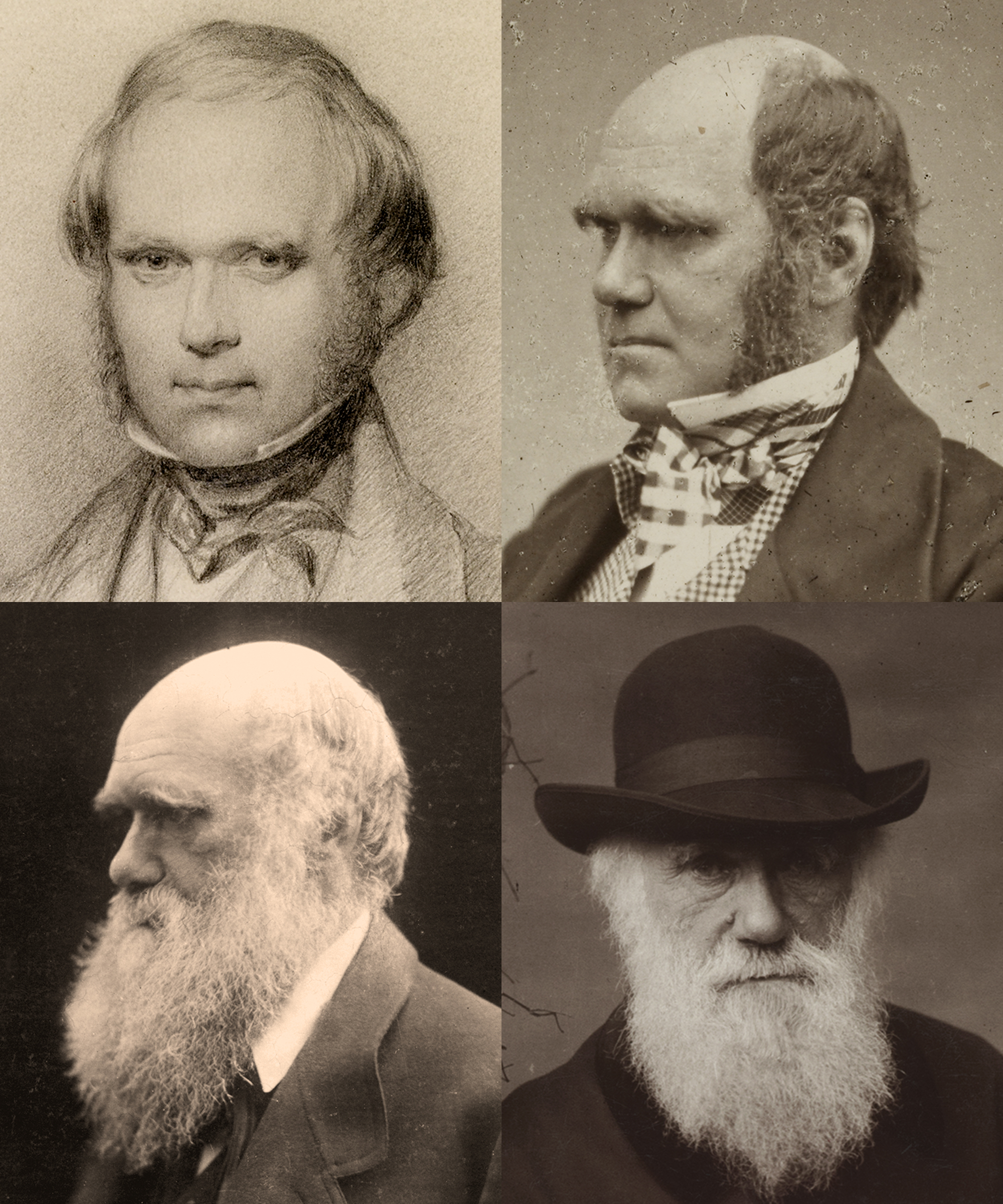
Darwin Persona from https://www.darwinproject.ac.uk/
with [no] permission from the Darwin Correspondence Project
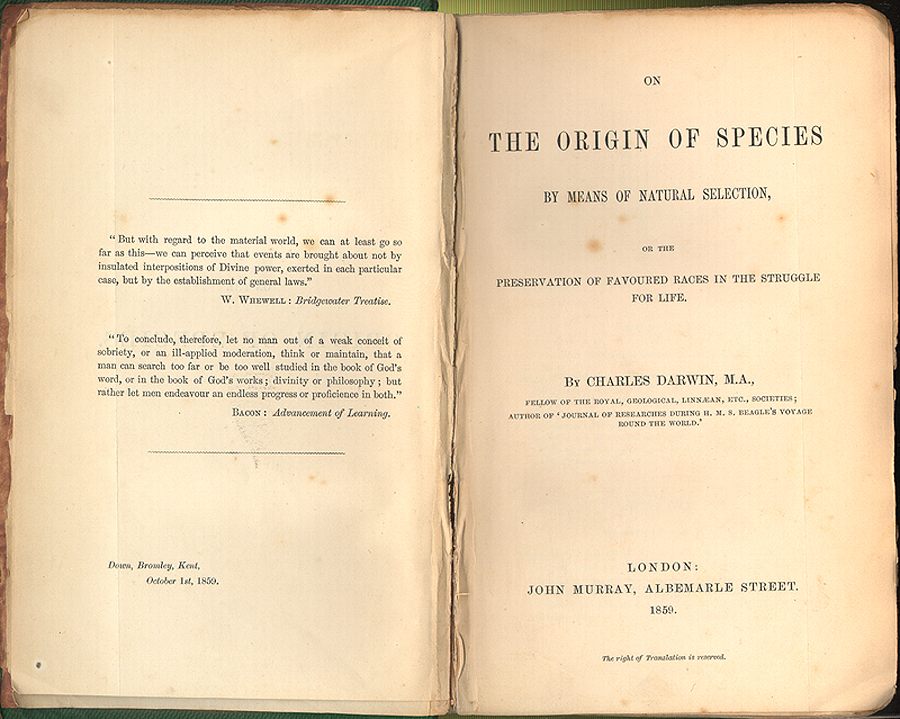
Importantly, the day celebrates the publication of one of the most transformative books and thoughts in the history of science: Darwin's On the Origin of Species (or more completely, On the Origin of Species by Means of Natural Selection, or the Preservation of Favoured Races in the Struggle for Life).

Darwin Origin

Like Galileo's Dialogue Concerning the Two Chief World Systems, which compared the two astronomic systems until that day: the Ptolemaic system and the heliocentric Copernican system, Darwin's Origin has been a game changer in the perception we have of ourselves in nature, or a paradigm shift.

The biggest change, in my humble opinion, is about switching one more time Homo sapiens importance in the natural order. Although particular, the humankind and its members we are just another species of animal.

We are a social animal, which is not a particular trait, we can communicate, also in another group, but we have a complex machinery language driven by an intentional stance, which spawns several thousands languages) and keeps evolving actual ones; we can foresee future events, or at least we do our bets effort trying to predict our best next actions. We think and write about ourselves and we ask questions like "why are we here". However from the big perspective, we are another animal roaming the surface of this small speck in the vastness of space... maybe for a few hundreds thousands of years...

Why is Darwin's Day so important?


I like to quote here the main concepts by the Darwin's Day dot org. It is about celebration:

  • Perpetual Curiosity
  • Intellectual Bravery
  • Hunger for Truth

Freedom of thought is best promoted by the gradual illumination of men's minds, which follows from the advance of science

Quote: "The mission of International Darwin Day is to inspire people throughout the globe to reflect and act on the principles of intellectual bravery, perpetual curiosity, scientific thinking, and hunger for truth as embodied in Charles Darwin"

More from darwinday.org website:

"Vision International Darwin Day will inspire people throughout the globe to reflect and act on the principles of intellectual bravery, perpetual curiosity, scientific thinking, and hunger for truth as embodied in Charles Darwin. It will be a day of celebration, activism, and international cooperation for the advancement of science, education, and human well-being.

Local and state governments will close in commemoration of the Day, and organizations and businesses will celebrate by engaging in community outreach centered around science as a tool for the betterment of humanity.

Darwin Day will be observed by the United Nations and its members as an opportunity for international partnerships through the common language of science for the common good of all.

On the Origin of the Celebration Ever since Charles Darwin published his radically insightful book, On the Origin of Species, Darwin has been the focus of commemorations and tributes by scientists, artists, scholars, and freethinkers throughout the world. From the early gatherings after his death at his own Downe House, to bicentennial events all over the globe, celebrating science and humanity within our various cultures internationally has been a resonant and transcendent pursuit.

In 1909, on the 100th anniversary of his birth, large celebrations honoring Darwin’s contributions to science and humanity were held in Cambridge, New York and New Zealand. The University of Chicago commemorated the 100th anniversary of the publication of On the Origin of Species in 1959 with a series of notable events from November 24 through the 28th. The 200th anniversary of Darwin’s birth saw an entire season of BBC programming on Charles Darwin himself as well as evolution and natural selection. Salem State University has successfully held an annual Darwin Festival since 1980."

My take why it is so important and interesting

It is about a question or many questions that everybody ask themselves or their parents:

  • why are so many things?
  • where were we come from?
  • what are we?
  • what is the origin of life?
  • are other intelligent being things out there?
  • and here on Earth?
  • And many other interesting questions...


The way to answer this in a factual way started with the ancient Greeks. Or at least many agree on that point. You can call it philosophy or naturalism, or science starting in the 1600's or something around that. In any case, it is a very simple method:


  • ask questions
  • think about possible answers
  • hypothesis
  • try to think about ways to test your possible answers
  • make sure you test in many different and independent ways
  • double blind tests and
  • if the results coincide with your hypothesis, and if it can make good predictions
  • Iterate

If future tests, or field findings coincide, you are in the good path... if the results do not coincide with the hypothesis, go to back and think about new possible answers.


Quote: "Test ideas by experiment and observation, build on those ideas that pass the test, reject the ones that fail. Follow the evidence wherever it leads and question everything. Accept these terms, and the cosmos is yours"
This method is powerful, and it has been the basis of everything that today amaze us: flying, going to the moon, flying to the Kuiper Belt, your TV/PS4/Wii/etc, vaccines, GMOs, etc. Just named it, you liked or not. It is all product of our ingenuity and building a web of interconnected facts and theories that support one to the other.

You cannot denied Evolution, without denying Geology. And if you deny it, you are at odds every time you start your car. Just think about that.

Resources

Resources Darwin 2017 - Virtual Issue []
What is evolution? Charles Darwin's brilliant idea explained
What is Evolution?
What is Evolution - PBS Library
Evolution Explained
What is the Evidence for Evolution? []
Video: What is the Evidence for Evolution?
Why Evolution is True?
Evolution FAQ

And for a No to alternative lies, please check TalkOrigins anytime you do not know something


11 January 2017

Breaking the Spell by Daniel Dennet - On Chapter 1 and the book


Daniel Dennet writes in Breaking the Spell a compelling introduction in a very open way and trying not to preach to the (atheist) chores, or his usual readers. He aims at reaching in a honest and brave dialog the religious mind people.


"Billions of people pray for peace, and I wouldn't be surprised of most of them believe with all their hearts that he best path to follow to peace throughout the world is a path that runs through their particular religious institution (...) indeed many people think that the best hope for humankind is that we can bring together all the religions of the world in a mutually respectful conversation and ultimate agreement on how to treat each other. They may be right, but they don't know" (page 16)


The first chapter is a carefully built argument that we truly do not know what are the effects of religion. At both individual and social level.


The argument goes both ways: to the ones that we believe religion is a source of problems, to a great majority that believe humans can not go without religion.


Dennet brings the point forwards that there is an asymmetry: atheists welcome the objective examination of their views (and willing to change if found wrong), but religious people often bristle at the impertinence, lack of respect, sacrilege at the suggestion of putting their beliefs under scrutiny.  (page 17)


And I have to add that it brings suspicion to their claim the simple reason that there are different and contradictory beliefs systems worldwide! A quick check put the number in the several thousands (more than 4000). It does not help that diversity to favor the argument of one true religion (or system of belief).

To bring the religious people to a rational analysis of their beliefs, first they should explain why there are so many religions!

For Dennet the opposition to analyze religions objectively and rationally it is an spell that must be broken. He emphasizes that it must be addressed now. When now was 2006! Ten years later this statement is still un-answered and critical as ever as much and much more religious ideas are entrenched as sacred and beyond any criticism. If there is something that express the most dangerous side of religious belief (my opinion, not Dennet's) it is the level of care that atheist, non religious or brights have to go in order to have a conversation with religious people.

Religion's belief is an off-topic most of the time. Including between friends. Dennet anticipates that his book will be offensive, repulsive at the level of people abandoning it. He anticipates a roller coaster of emotions. Most of the religious people he interviewed researching for the book admitted never talked to anyone like him: an atheist a non believer.

He mentions that these topics are delicate, about embarrassing communications and whatever his efforts to treat the matter with kindness and respect, he is sure that he will outrage some readers (religious people of course).

He ask those potential readers to soldier the effort to read his book and consider carefully and rationally in which points they disagree and why.

If you think that this is exaggerated, just read the news were people gets attacked because they are blasphemous, something that spread from religious countries to secular countries.

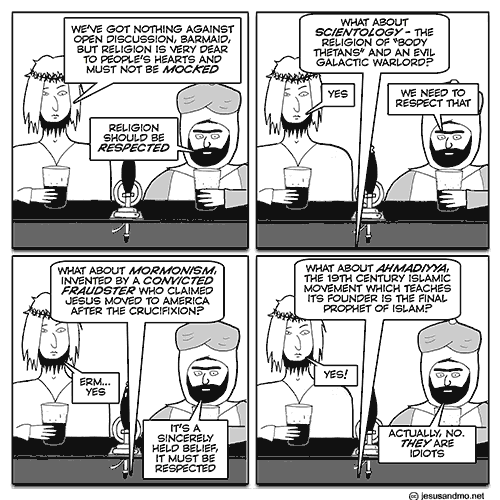
The self censorship of many newspapers not publishing the first page of the Charlie Hedbo magazine after the hideous attack to their offices it is a clear sign of this problem.


Dennet will explore in following chapters more about how ideas (memes) that build their own ideas to protect themselves can be dangerous. Religion belief, as a meme/idea, self-protect with circles of convoluted logic. And with other ideas that reject a priori any logical analysis.

How many times an atheist is confronted with incredulity and being asked things like: you do not believe? How comes you are a good person? (and some others: http://www.alternet.org/belief/9-questions-atheists-might-find-insulting-and-answers)

Other ideas to help fence the main idea (belief on belief) are things like all religions are the same, and the basic behavior of separating people from one belief from another and particular atheists.

If you need one more argument, here a short story:


With names and relationships edited, for the reasons stated above (!)

This is the story of two friends: one is very religious, or comes from a very religious family; the other the family does not care about the topic and they do not have any religious affiliation: nones. [Dennet will go on his book more about the topic if children should be indoctrinated with their parent's religion]. The religious kid is sent every summer to a camp in UK. A religious based summer camp. They invited the other kid and the family said "yes, go if you want".

The 2 kids had a great week, and the activities were super well organized. The people were professional and know what they were doing, and they were super nice.

Most of the activities are what you expect from a summer camp in the outdoors: hiking, games, songs, organizing the camp, etc. And the 2 kids had a fantastic time together.

Being a religious based camp of course there is religion: only 5% of the activities were about talking on religion  (christian based Church of England). Several questions our daughter asked to us about that. And this little gem.

One day in the summer camp, they talked about hell, and that people that do not believe go to hell automatically [express application form I would say]. The religious friend concerned about her non-religious friend asked to the nice people that if she prays every night for her best friends to not go to hell, that will prevent them for going to hell? And they answered "No, no way. They will go to Hell regardless".

How can you do that to a kid??? The non-religious kid had no issue (yes, hell is as real as Santa Claus and the North Pole for her, which is true), but her friend: she believes, she has best friends that are not believers in her particular religion, they will go to hell, that she thinks is a real place, and praying to her loving-good god, will not save her best friends. How you can psychologically torture a kid with that?

If you do not see the slippery slope down to violence at the very end...

If you have never felt like talking about religion was problematic means that you are religious. As an atheist you know that you have to be sensitive and not talk about it, including in open societies. Or, not ironically, you are member of the main religion in your country. If you are a minority again you know that you cannot touch those topics.

Dennet wishes that religious people reading his book "will learn something and then may be able to teach us all something " (page 22).

A great and optimistic thought. It gets downsized when from personal experience that not even with a close and very religious friend you can touch these topics without risking your friendship.

In page 23 he makes this point painfully clear "They think that they should be closed-minded when it comes to certain topics. They know that they share the planet with others who disagree with them, but they don't want to enter into dialogue with those others. They want to discredit, suppress, or even kill those others".Strong disclaimers for the first pages of a book!"So what, then, is the point of religion?" ask Dennet at the end of the chapter 1.

Books and references:

23 November 2009

Ojo con las copias truchas

Esperando que se venza el copyright sobre el Origen de las Especies, un tal Ray Comfort va a publicar una versión con una introducción sui-generis, o creacionista. Al menos de manera medio oculta y torcida. El National Center for Science Education, o NCSE ha creado un sitio para explicar porqué razón este señor mea fuera del tarro, literalmente: Don't Diss Darwin.

Se tomaron el trabajo de marcar porqué está equivocado Ray Comfort párrafo a párrafo de la introducción, y además un buen listado de sitios para aprender biología 101 y Evolución en particular.

Agrego mi humilde lista de libros fantásticos para leer sobre Darwin y Evolución en general:

Enjoy!